By Elizabeth R. Auma K, Trade Policy Leader/Bridging Policy, People & Purpose/ Founder, Hearts& Trade
Many years ago, I wondered why a particular prayerful group of women I knew was perpetually broke. I then ventured into the study of the wise and wealthy King Solomon. I am currently in the advanced stages of finalizing a book on my findings. However, I found some key reflections from my study applicable to nations, especially at a time when geopolitical tensions are escalating faster than agriculture can yield its rewards. The more practical question is about what nations can learn from wisdom that has already been tested and proven over time. In such moments, Biblical history offers a deeper appreciation and understanding of how the same knowledge could be translated into national development.
”Why King Solomon?’’ King Solomon remains a non-negotiable authority on wisdom, wealth, and governance. In the book, The Richest Man in Babylon, George Clason wisely warns not to seek wisdom on jewelry trade from the brick maker and asks whether one would go to the bread maker to inquire about the stars. I believe it is only wise for leaders and policy makers of our times to seek wisdom from a man whose leadership recorded economic growth for Israel. While his story is ancient, the principles behind it remain strikingly relevant to the economic questions nations face today.
Like in the past, nations today seek to grow their economies and register sustainable transformation. Today, many countries have developed National Development Plans aimed at ensuring economic growth in a landscape characterized by growing populations, competing global demands, and climate change, among others. Developed countries are not spared either, hence setting strategies to remain resilient and maintain influence on the global landscape.
As I reflect on trade policy, I realize that many of the current trade and economic-related challenges are not new. Like the ancient, they revolve around infrastructure, leadership, policy implementation, innovation, value addition, exports and imports, partnerships, skills, among others. Thousands of years later, the principles King Solomon applied still form sustainable, actionable points not just for individuals pursuing growth, but to nations shaping their economic direction. Many nations may have already applied these principles, knowingly or unknowingly. Today, this is a call for leaders and policymakers to become more intentional. From this, several lessons emerge that speak directly to how nations can approach trade and development
- Wisdom before wealth
I recall a story shared during my early high school years. A wealthy man, concerned that his son seemed uninterested in the responsibility of the family estate, gave everything he owned to the management of a dedicated and more responsible servant. Out of a father’s heart, he later allows the son to at least pick one of the valuable assets in his ownership: “Son, ask for one thing from all I own, and it will be yours.” The son replied, “Give me your slave.”
When God presented King Solomon with a blank cheque, Solomon asked for wisdom to govern with discernment (1 Kings 3:9). God was impressed, and in addition, He granted Solomon wealth.
For developing nations, this is the first lesson. It is not enough to pursue export growth, market access, or investment flows. These opportunities will always be there. It is important to be guided by policy decisions that strategically respond to:
- What are our non-compromising values as a nation?
- What sectors build long-term value for our people today and tomorrow?
- Which partnerships strengthen national interest while respecting humanity?
- What trade-offs are we willing to make and at what cost?
Growth often becomes a by-product when these questions are answered with wisdom and integrity. However, when policymakers ask the wrong questions, they get wrong answers. The right questions answered with the wrong intentions equally result in self-centered outcomes. Like in Solomon’s time, the consequences of a leader’s decision do not affect one man but the entire nation. Therefore, the decisions of trade Policy decision makers affect an entire nation.
Wisdom, however, does not operate in isolation. It must find expression in action, and in our scenario, the action is seen through trade and its impact on a country.
2. Trade is exchange
Even after receiving wisdom, Solomon’s wealth did not fall from heaven; neither did the earth suddenly produce more crops or gold for him by chance. His wealth was built through the exchange of goods, services, and his intellectual property. I have come to appreciate that nations do not seek nations because they are sovereign States but because of what each nation has that they need. There are 44 Least Developed Countries (LDCs) according to the United Nations categorization; however, these countries still have other developing and developed countries seeking partnerships with them in various ways. I recently listened to a debate on preferential treatment for Least Developed Countries (LDCs). Some said LDCs had benefited while others said they had lost more than they would have gained over the years. That is an area I am further interested in analyzing. Nonetheless, it is important to know that LDCs have something of value they can equally bring to the global table. Therefore, a nation that seeks economic growth must think beyond what it receives from the global table and focus on what it contributes to it.
In ancient times, trade was based on barter (good for good), where value was exchanged for value. That principle remains today. However, not all exchange leads to transformation, and this is where many economies begin to fall short.
3. The nature of the exchange matters
All countries trade goods or services, yet not all countries can boast of a high level of sustainable transformation. This implies that not all trade creates transformation. For many African economies, the biggest challenge is that we are exporting what I call potential rather than value. Selling more raw materials as opposed to finished goods or high-value inputs is giving away Africa’s potential and opportunity to lead. This imbalanced trend is reflected in real economic indicators, such as export performance, industry sophistication, and national income.
A further appreciation of this pattern can be seen in how some economies manage wages and production. A friend of mine once reminded me of a key economic principle when I questioned certain proposed taxes. When wages increase without a corresponding rise in production, prices go up. Governments may then respond by increasing taxes to reduce disposable income. The result is an economy where money circulates, but little real value is created because of no or limited production. I liken it to a fan in a closed room, yet the occupants are complaining about stuffy air.
King Solomon did not merely possess gold; he transformed the gold into what was needed: high-value goods such as swords. Therefore, it is important for nations to strategically develop and transform their resources; what a country possesses, such as minerals or human resources, is not what makes it economically sustainable, but how these resources are utilized.
In exchange, we must recognize that trade is not charity. Trade is the pursuit of value: the ability to obtain what is needed, when it is needed, in a mutually beneficial way. Therefore, beyond what is exchanged, the mindset that drives trade is value.
4. A profit mindset
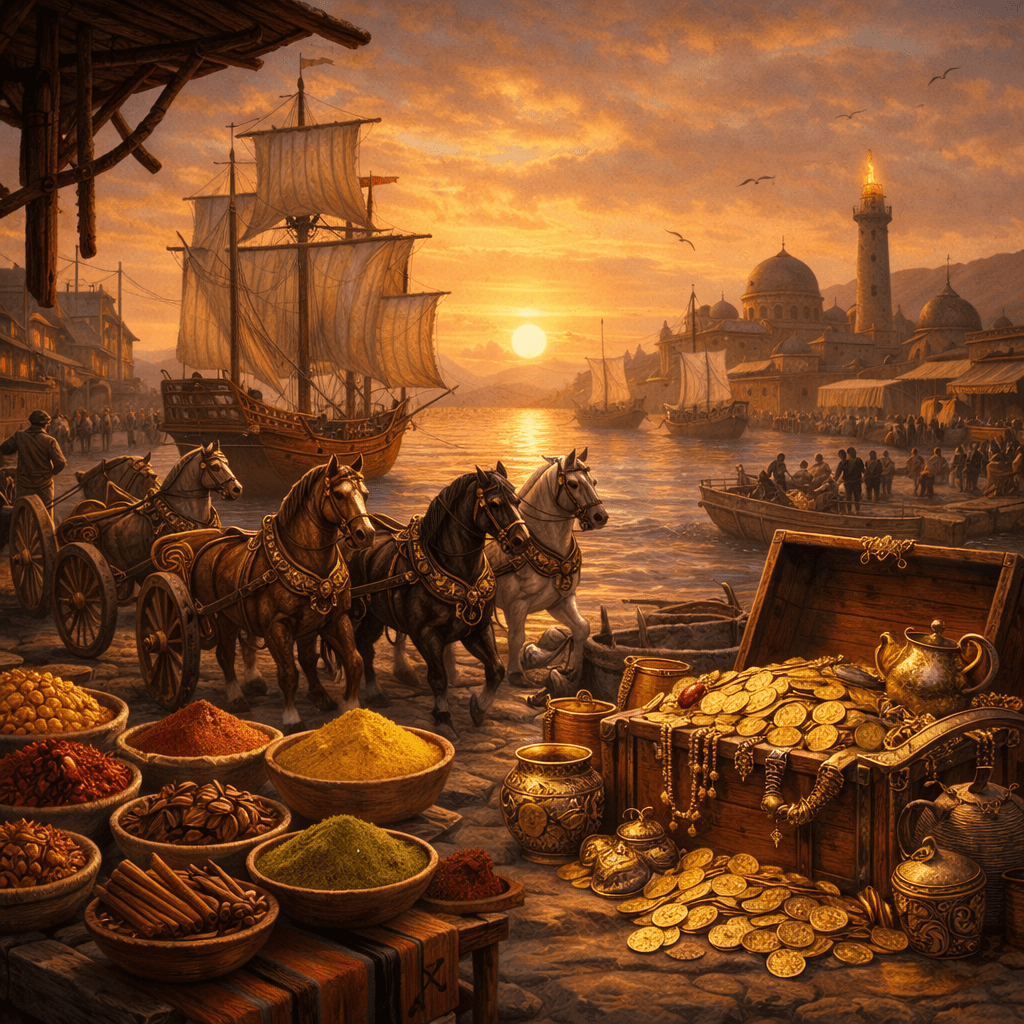
Solomon’s royal merchants operated with a profit mindset strategy: Buy horses and chariots and re-export (1 Kings 10:28–29). In today’s world, when a country re-exports, it does so for a value higher than the previous purchase value. The intention is to make a profit as a reward and for sustainable reasons. Businesses that consciously incur losses cannot be competitive. Trade must therefore aim for sustainability. A profit-driven mindset naturally opens the door to another critical dimension of trade: diversification.
5. Trade diversification
The concept of trade diversification is not as new as it may sound in our policy rooms. Solomon’s wealth did not come from one source. It came from ships trading at sea, revenues from the merchants and traders, natural resources, partnerships, and intellectual property. (1 Kings 10:14-15, 22). King Solomon, therefore, teaches economies of today that in a world shaped by geopolitical tensions, climate change, and shifting markets, diversification of products, services, and partnerships is not optional; it is essential.
6. Efficient and effective Systems
My many years of trade policy have taught me that strategy alone is not enough to develop a nation. Nations need systems that support the strategy. On many occasions, I have sought services from both the public and private sectors, only to be told I can’t be served because the person who handles that particular job is away. For how long, I don’t know, but you can call or come back tomorrow. One of the greatest barriers to economic growth is reliance on individuals instead of systems. Solomon’s wealth was attributed to him, yet he was not physically present in every transaction. His leadership built systems that worked (2 Chronicles 9:13-14).
In the case of trade, this would mean efficient border systems; transparent regulations; digital trade facilitation, or institutions that outlive leadership cycles. A trade system that only works with the physical presence of leaders is a weak system. Leaders follow a 24-hour cycle, which includes sleep, yet the exchange of goods or services knows no clock. Imagine ships ferrying gold docking up at Israel’s ports, and the revenue guy says, ‘Sorry, the king is not here this week, try calling him.’ I doubt the King would be receiving the revenues and gold the traders brought.
7. Invest in Infrastructure
Systems, however, must be anchored in something tangible and visible. Solomon built cities and storage systems (2 Chronicles 8:6). Nations today have understood that hard infrastructure, such as roads, rail, and ports, is not separate from trade policy. Both hard and soft infrastructure are trade policies in action. Unfortunately, today, many developing countries have infrastructure in the urban areas and leave the village/rural areas where a lot of economic activity, mainly agriculture, takes place. King Solomon did not leave out the villages; he rebuilt them. Infrastructure must reach every part of the economy for it to be considered holistic national development. Mama Sarah must be able to transport the maize from her garden to the mill at a price that leaves her more empowered than contemplating whether to continue investing her time in growing food that feeds the world. She must be able to access the internet at every opportunity to know the latest information on the price and demand for maize, given the partnerships her government has signed across the globe.
8. Build Strategic Partnerships
Solomon partnered with King Hiram, leveraging expertise he did not possess (1 Kings 9:27–28). King Solomon had the ships, and King Hiram had the skilled seamen. The two worked together, acquired gold, and brought it to King Solomon. Developing countries need to leverage the expertise of other countries. However, the outsourced expertise, or support, must translate into local expertise for sustainable growth long after the partnership ends. One of the best strategies of any leader, therefore, is strategic partnership. However, strategic national partnerships must be a win-win for the partnership to be sustainable.
9. Invest in knowledge and continuous learning
In an ever-evolving global landscape, one resource remains critical to sustaining all others. Despite his wisdom, King Solomon continued to seek understanding (Ecclesiastes 7:25). Today’s global economy is evolving rapidly, with digital trade, artificial intelligence, and green transitions. It is, therefore, a disservice when policymakers and business owners cling to outdated knowledge. In my previous post https://heartsandtrade.com/2026/03/25/africas-trade-policy-adapting-to-global-changes/ the importance of adapting to global changes is essential for transformational growth, which involves continuous learning. When knowledge is properly nurtured, it transitions from insight into a valuable economic asset.
10. Intellectual Property
Solomon’s wisdom itself became an asset. Kings and queens traveled from far and near to hear him, bringing gifts year after year (2 Chronicles 9:23-24). Each man brought his present, silver and gold, garments, armor, spices, horses, and mules. Knowledge and applied knowledge create value. Developing countries must therefore ask:
- How can we become knowledge hubs?
- How can we export ideas, innovation, and expertise?
- How can we leverage intellectual property?
Conclusion
King Solomon’s story reminds us that economic growth is not acquired by luck or accident. It is built, multiplied, and sustained through applied wisdom in the resources that a nation possesses.
Africa and the world at large are not short of opportunities. Israel, before and during the reign of Solomon, was not short of opportunities. What set Solomon apart was his wisdom to recognize and position Israel to benefit from opportunities within and beyond its borders. Trade Policy makers and decision makers, therefore, need to apply wisdom that recognizes opportunity, builds systems to harness it, and exercises the discipline to sustain it.
From reflecting on the lives of the prayerful women, I have come to conclude that just as prayer alone does not make a woman economically empowered, nations do not become economically transformed by writing powerful trade policies but by strategically doing what King Solomon did. The Queen of Sheba recognized Israel as a benchmark nation because the results were visible. For a nation that rises to win, the world shall recognize it. The question to Africa and the developing economies: Shall we be recognized?


 Hearts & Trade
Leave a comment